Mechanical Beauty in Motion and Future Responsive Architecture
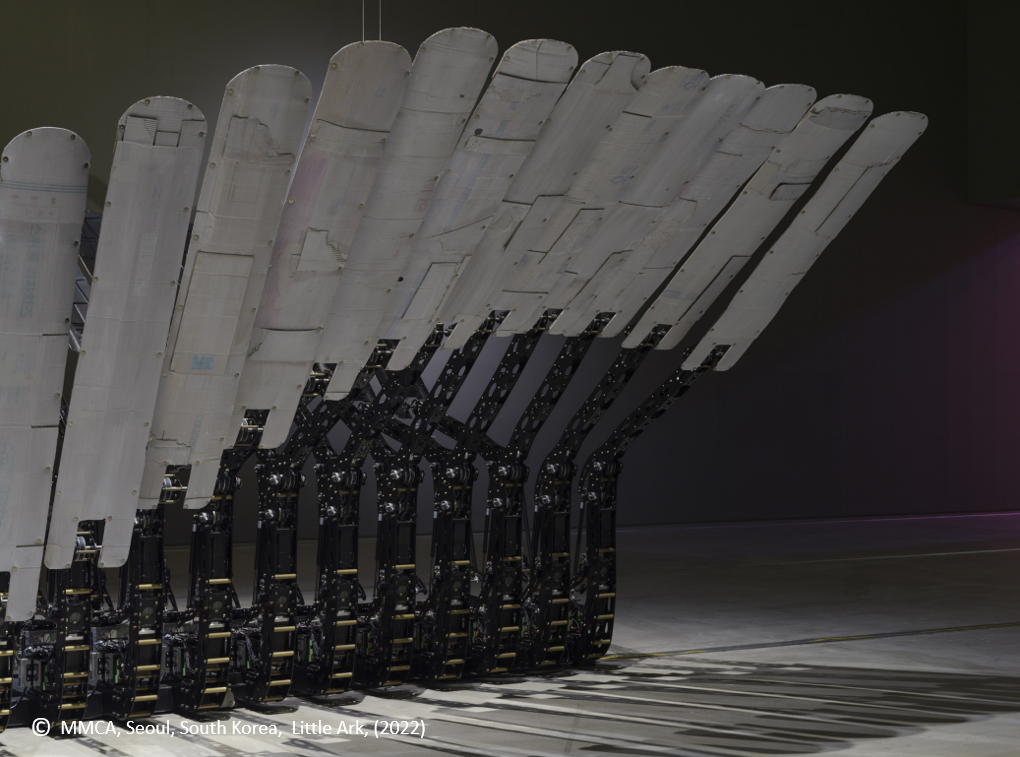
The Little Ark, a collaborative artwork by Hyundai Motor Company’s Robotics Lab, Hanyang University’s Department of Robotics, and artist Choi Woo-ram, exemplifies the mesmerizing beauty of moving mechanical devices. We human beings are naturally captivated by machinery’s silent, rhythmic movements, especially when these devices are larger than life. Because we admire humanity’s ability to imbue inanimate objects with lifelike qualities, even the simplest repetitive motion evokes awe. These movements offer a glimpse into a future often drawn from the pages of science fiction.
The aesthetics of kinetic sculpture constantly breathe fresh air into monotonous objects as it transforms the space. As materials and technologies evolve, the creation of mechanical life forms becomes ever more sophisticated. This pursuit to emulate nature-like movement through the lens of science and technology is a trend permeating the art world, music, architecture, and beyond.
Upon reflection, it’s evident that unseen mechanical systems also power our lives and cities. Subways, hidden beneath layers of earth, run silently through tunnels 10 to 50 meters underground, while elevators in skyscrapers ferry people to great heights. Building facades, now dynamic canvases of media, shift and change rapidly. We traverse cities without ever touching our feet on the ground.
What, then, will the next generation of responsive architecture look like? And how will we, the inhabitants of these ever-evolving cities, adapt to and embrace spaces that move and change with us?